
Wrinkled packaging on an otherwise good product. Burn marks where the seal should be clean. Film that shrinks unevenly and leaves one corner puckered. These are not random defects — they are symptoms of a mismatch between heat settings and film type. Packaging lines that run shrink film without clearly understanding the thermal behavior of the material they are using will chase these problems indefinitely, adjusting tunnel temperature up and down without a clear basis. The comparison between Shrink Film POF and PVC starts with understanding why heat response differs between them, and why that difference shapes everything from sealing quality to machine speed to the appearance of the finished package.
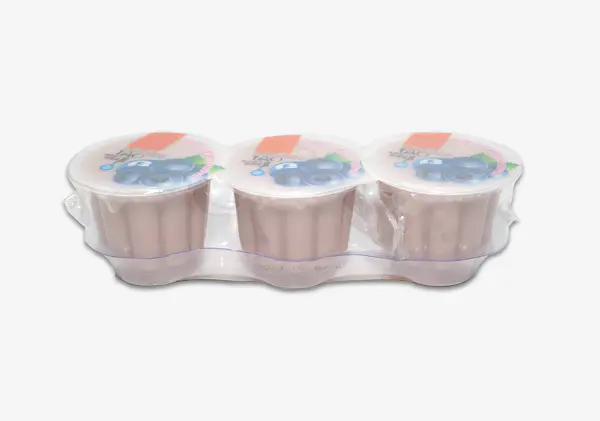
Shrink film responds to heat in a specific, material-determined way. It is not simply a matter of applying enough heat to cause contraction — the temperature must fall within a range narrow enough to activate the shrink without crossing into degradation. Below the activation threshold, the film wrinkles because it has not contracted fully. Above the ceiling, it burns, distorts, or develops haze that ruins the visual finish.
What makes this more complex is that POF and PVC do not share the same thermal response curve. Each material has its own activation range, sensitivity to temperature variation, and tolerance for tunnel speed adjustments. Running both through the same settings is one of the more common sources of persistent packaging problems on lines that switch between film types.
Both POF and PVC are polymer films that have been stretched during manufacturing — a process that orients the molecular chains under tension. When heat is applied, those chains relax back toward their unstretched state. The film contracts. The tighter and more uniform the original orientation, the more controlled and even the shrink behavior.
This molecular memory is what makes shrink packaging work. But it also means the film will only shrink correctly within a temperature window that matches the polymer's relaxation behavior. Apply heat below that window and the chains do not move enough. Apply too much and the structure breaks down — the film does not just over-shrink, it weakens, whitens, or burns at the seal points.
Understanding this helps explain why the comparison between POF vs PVC Shrink Film is not just about material preference. It is about how each polymer's thermal behavior interacts with the packaging machine's heat output.
PVC activates at relatively low temperatures and responds quickly to heat. That speed makes it suitable for certain applications — simple, lower-speed lines, non-food packaging, and situations where a fast, firm shrink is wanted around a rigid product shape.
The trade-off is a narrow working range. PVC does not tolerate temperature variation well. A tunnel that runs even slightly hot produces burn marks, visible brittleness at the seal, or yellowing of the film surface. Cooling unevenness across the tunnel width creates asymmetrical shrink — one side tight, the other loose.
Additional factors that complicate PVC heat management:
For high-speed automated lines or food packaging applications, these characteristics create ongoing adjustment demands that add to operational overhead.
POF — polyolefin film — operates within a wider activation temperature range than PVC. That broader window means the film tolerates normal tunnel temperature variation without the same sensitivity to precise calibration. A tunnel running slightly hotter or cooler than the set point does not immediately produce visible defects.
This stability translates into several practical advantages for production environments:
The food safety dimension also favors POF. It does not release chlorine compounds under heat and carries food-contact certifications for direct product packaging — a requirement that PVC cannot meet in many food production environments.
The differences between these two film types come into focus when laid out across the variables that matter in production:
| Property | POF Shrink Film | PVC Shrink Film |
|---|---|---|
| Shrink temperature window | Wider range | Narrower range |
| Heat sensitivity | Lower | Higher |
| Burn / defect risk | Lower at standard settings | Higher with minor overheating |
| Clarity and gloss | High, consistent | Good initially, may yellow |
| Food contact suitability | Yes, widely certified | Limited, chlorine concern |
| Cold temperature behavior | Flexible, durable | Brittle over time |
| High-speed line compatibility | Strong | Requires tighter control |
| Environmental considerations | More recyclable, no chlorine | Chlorine content, disposal concerns |
| Seal quality consistency | High | Variable with temperature drift |
Neither material is appropriate for every situation. PVC still has a place in packaging applications where its characteristics are a natural fit and regulatory requirements do not preclude it. But the direction of travel across industrial packaging sectors is clearly toward POF as a versatile, food-safe, and process-stable alternative.
Setting up a shrink tunnel for POF versus PVC involves different starting points and different tolerance logic. Getting this wrong is one of the more frequent causes of switching-related defects when a line changes between film types.
For POF:
For PVC:
Switching from PVC to POF on an existing line almost always requires a recalibration session rather than a simple set-point change. The film behaviors are different enough that settings dialed in for one material will not produce consistent results on the other.
Wrinkles are one of the more visible and persistent defects in shrink packaging, and the cause is not always the film. Diagnosing correctly requires separating film-related causes from machine-related ones.
Film-related wrinkle causes:
Machine-related wrinkle causes:
Wrinkle diagnosis starts with separating the film side from the machine side. Changing film type without addressing machine-side causes will not resolve the problem — it will simply change its appearance.
High-speed packaging lines create conditions that test film performance more aggressively than slower manual or semi-automatic setups. Film must seal cleanly at high cycle rates, shrink consistently across a range of product sizes without re-calibration between runs, and handle the mechanical stress of continuous feeding without tearing or stretching at feed points.
POF handles these conditions well for several reasons. Its molecular structure is more uniform than PVC across production batches, which means its mechanical properties — tensile strength, elongation before tear, and seal strength — are more consistent from roll to roll. On automated lines running multiple shifts, that consistency reduces interruption rates and waste from film breaks or defective seals.
For buyers sourcing from a POF Shrink Film Factory at volume, batch consistency is a specification worth confirming explicitly — not just from a single sample but across production lots, since variation between batches is where high-speed line performance becomes unpredictable.
The seal is the structural and visual anchor of a shrink-wrapped package. A weak seal opens. An over-heated seal looks burned or forms angular distortion at the edge. A seal with inconsistent heat contact produces a wavy or uneven edge that signals quality issues even when the product inside is undamaged.
POF seals consistently across a wider range of sealing bar temperatures than PVC. The film fuses cleanly without needing the bar temperature to hit a precise narrow range. This is particularly valuable on older equipment where bar temperature consistency has degraded, or on lines where the sealing station does not have precise closed-loop temperature control.
Seal quality checks to run during any film changeover:
These checks take a few minutes and prevent hours of rework on a full production run with the wrong settings.
Heat settings and film selection are only part of the equation. The film itself must be produced consistently enough to behave predictably under those settings across every roll in a production run. Zhejiang Jiuteng Packaging Co., Ltd. manufactures POF and related shrink film products for industrial and food packaging applications, with production processes focused on dimensional consistency, shrink ratio uniformity, and batch-to-batch stability. For packaging operations evaluating film type, sourcing from a supplier who can provide product specifications matched to your line's heat profile, along with sample rolls for trial calibration, reduces the uncertainty in the changeover process. If you are reviewing your current shrink film supply or considering a move from PVC to POF for food safety, performance, or regulatory reasons, reaching out to discuss your packaging specifications is a straightforward starting point.
JT05 Antifog Crosslinked Shrink Film is an ideal o...
Copyright © Zhejiang Jiuteng Packaging Co., Ltd.
 简体中文
简体中文
 Home
Home
