
Twenty minutes into a packaging shift, the supervisor pulls a finished bundle from the shrink tunnel and holds it to the light. The film is cloudy, the corners carry dog ears, and a fingertip pressed against the side leaves a permanent dent. The shift log says this roll ran perfectly yesterday.
Shrink film quality is not a single number on a specification sheet. It is the combined result of raw materials, production conditions, machine settings, and storage habits. Understanding which factors affect shrink film quality, and how they interact, separates a predictable packaging line from one that produces surprises.
Key takeaway: film quality is a chain of variables. The strongest specification can be defeated by a single weak link.
The most important factor affecting shrink film quality is the resin and additive system. A film made from virgin, premium-grade polyolefin resin starts with a clear advantage in transparency, shrinkage uniformity, and strength, compared with film produced from poorly controlled or heavily recycled feedstocks. The raw material sets the ceiling for every property that follows.
Zhejiang Jiuteng Packaging begins with imported high-quality raw materials and tracks every batch through biaxial orientation, slitting, and folding. The additive package matters as much as the base resin. Slip agents control the coefficient of friction for smooth automatic feeding, antifog additives prevent condensation on chilled food packs, and antistatic agents reduce dust pickup. When masterbatches are not dispersed uniformly, the film develops streaks, erratic shrinkage, or unstable sealing that no tunnel adjustment can fully correct.
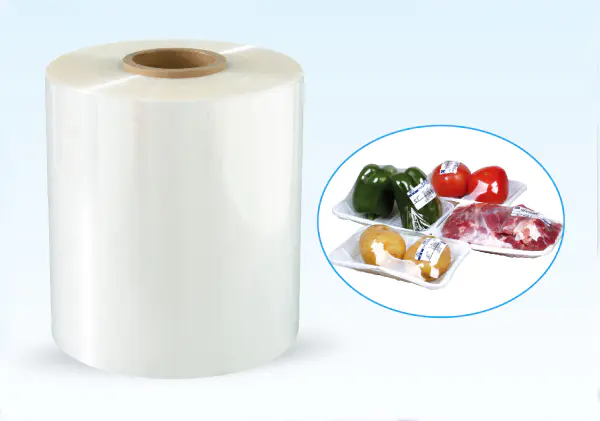
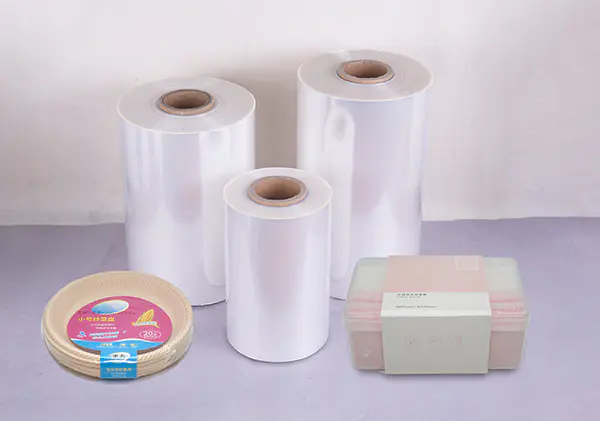 Balanced Polyolefin Shrink Film for Standard Packaging TrialsThis biaxially stretched POF film offers a dependable starting point for shrink packaging evaluations. Its balanced formulation and clear presentation suit buyers testing film behavior under real line conditions.View Product →
Buyers who need a dependable starting point typically base their trials on a standard polyolefin shrink film with a balanced formulation, then test how the next factors behave under real line conditions.
Most specifications quote an average film thickness, but averages hide real problems. Gauge variation, the difference between the thickest and thinnest areas of the roll, is the usual cause of dog ears, tunneling, and uneven shrink. A nominal 15-micron film with poor process control can vary by plus or minus 20 percent across the web, and that variation appears directly in the shrink tunnel.
The table below summarizes the defects that an inconsistent gauge profile can create.
| Packaging Defect | Typical Gauge Issue | Where It Appears |
|---|---|---|
| Dog ears at the corners | Thick edges shrink more slowly than the thin center | Bundles and multi-packs |
| Tunneling along the length | Thick center collapses slowly between thin zones | Bottles and tall products |
| Localized weak spots | Thin areas overheat and rupture | High-shrink applications |
| Optical distortion | Gauge variation changes light transmission | Retail display packaging |
Quality POF shrink film is normally held to roughly plus or minus 10 percent gauge tolerance, while the best producers hold an even tighter profile through precision extrusion and controlled orientation. Evaluate suppliers by requesting a gauge profile across the roll width rather than accepting a single average value. The practical process for choosing the right gauge for shrink film POF depends on product weight, shape, and required shrink energy.
Final film quality is judged by how well the film conforms to the product after the heat tunnel. The critical data are free shrink, the percentage of shrinkage at a given temperature, and shrink force, the tightness with which the film grips the product. High free shrink with low shrink force produces a loose package; the reverse can crush fragile items.
The heat window is the second half of the equation. A narrow shrink window forces a painful trade-off: raise the tunnel temperature and risk the product, or slow the line and lose output. For temperature-sensitive goods such as chocolate, cosmetics, and pharmaceuticals, a low temperature shrink film is formulated to shrink completely at lower tunnel settings, protecting the product and preserving line speed.
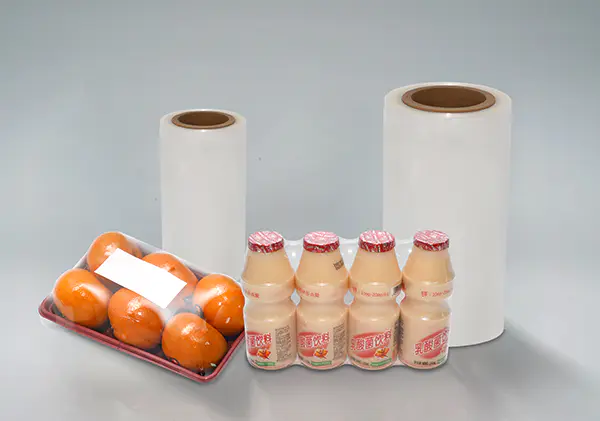 Low Temperature Shrink Film for Heat-Sensitive ProductsThis film shrinks fully at lower tunnel settings, protecting temperature-sensitive goods like chocolate and cosmetics. It maintains flexibility and clarity while preventing label melting or container deformation.View Product →
A practical rule: the film should reach its recommended shrinkage at a temperature safely below the heat tolerance of the product inside.
A perfect shrink shape cannot save a package whose seal fails. Weak seals open in transit, and burst seals inside the tunnel are among the most common reject reasons on packaging lines. Seal quality depends on the film's sealing temperature range, plus the seal bar temperature, dwell time, and pressure on the packaging machine.
High-speed lines also need films with controlled hot slip behavior, meaning the film does not stick to the sealing jaws or to itself while the seal is still warm. A wide sealing range tolerates normal machine drift and prevents intermittent weak seals from appearing late in a long shift.
Shrink film quality has meaning only in context. A film that shrinks beautifully but punctures on a pallet, or tears during handling, has failed its purpose. Tensile strength, tear resistance, puncture resistance, and impact resistance determine how a package survives stacking, vibration, and the occasional careless forklift.
Crosslinked shrink film raises this factor to another level. Molecular crosslinking builds a three-dimensional network that improves puncture and tear strength without sacrificing transparency. That is why specifiers choose it for heavy tools, sharp-edged hardware, and cases of bottled beverages. If your packages travel through rough logistics channels, compare a crosslinked structure against a standard film in your own drop test.
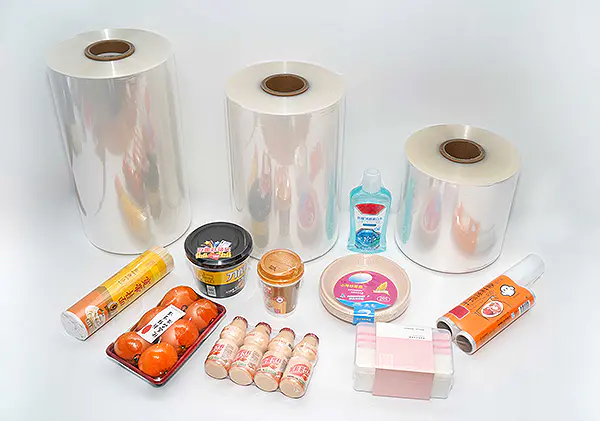 Crosslinked Shrink Film for Durable High-Strength PackagingA molecular crosslinked structure enhances puncture and tear resistance without sacrificing transparency. This tough film suits heavy tools, sharp hardware, and beverage cases exposed to rough logistics.View Product →
For retail packaging, optical quality matters as much as strength. Haze, clarity, and gloss determine how clearly labels and product details are seen through the film. High haze looks cloudy, low clarity blurs fine print, and low gloss leaves the package dull under store lighting.
Optical defects usually trace back to raw material quality, extrusion temperature control, and additive dispersion. Gauge variation also distorts the image of the product inside. For a brand owner, clarity is not cosmetic; a package that looks slightly off creates an impression of a product that is also slightly off.
A film roll can leave the factory with perfect quality and still fail on your line if it is stored badly. Humidity, heat, pressure, and time are all factors affecting shrink film quality. Rolls kept in a hot warehouse pick up moisture and develop blocking, where the layers stick together and refuse to unwind cleanly at the forming head.
Store shrink film in its original packaging, on its side, in a cool dry area away from direct sunlight and heavy pressure, and rotate stock so older rolls are used first. Even the best film has a shelf life. A degraded roll appears as poor shrinkage, weak seals, or excessive scrap. Most suppliers publish storage and handling guidelines for polyolefin shrink film because performance is a shared responsibility.
When buyers compare suppliers, the decisive factor is consistency across batches. A trial roll can look outstanding; what matters is whether the tenth truckload behaves like the first. Consistency comes from raw material control, calibrated extrusion and orientation lines, inline thickness monitoring, and inspection at every step from film web to finished roll.
Certifications such as ISO and BRC provide a useful framework, but the more practical test is traceability.
A manufacturer that can answer these questions with real data is far less likely to surprise you with the next shipment. The same logic applies to every factor affecting shrink film quality: it must be controlled before the film reaches your warehouse.
Raw material quality is the foundation. If the resin and additive package are not right, no amount of machine tuning can fully fix shrinkage, strength, or clarity. Gauge consistency and sealing behavior are the next most visible contributors on a real production line.
Ask for documented specifications covering gauge uniformity, free shrink and shrink force over a range of temperatures, seal strength, and optical properties. Then run a sample on the same tunnel settings used in your production and inspect corners, edges, and seals for dog ears, tunneling, and weak points.
Dog ears are usually caused by uneven gauge distribution, excessive shrink temperature, or a film whose shrink window is too narrow for the package shape. Check the gauge profile and reduce the heat to see whether the ears disappear before adjusting the machine.
Yes. High temperature and humidity accelerate oxidation and blocking in polyolefin films. Rolls stored in hot, damp conditions can lose transparency, become difficult to unwind, or shrink less uniformly than fresh film.
Shrink film quality is rarely a single point of failure. It is a chain that runs from resin selection to the storage rack, and it breaks at the weakest link. Buyers who understand these factors, and who choose a supplier willing to share real process data, see fewer rejects, fewer machine stops, and fewer returned packages.
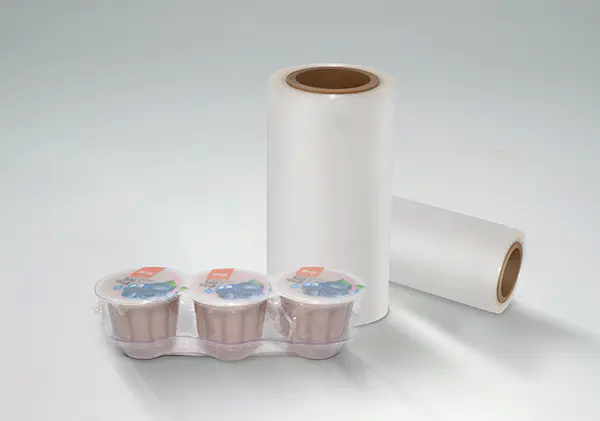
JT05 Antifog Crosslinked Shrink Film is an ideal o...
Copyright © Zhejiang Jiuteng Packaging Co., Ltd.
 简体中文

 Home

