
You have a pallet of bottled drinks, a stack of board-game boxes, or a bundle of steel brackets that needs a tight, transparent cover before it ships. The short answer to "how do you shrink wrap" is simple: slide a heat-shrinkable film around the product, apply even heat, and let the film relax into a smaller shape. The practical answer involves picking the right film, setting the right heat, and knowing why the film wrinkles, tears, or sticks when something is off.
Shrink wrap works because of a property called orientation. Manufacturers stretch the film while it is hot and then cool it quickly, which locks the polymer chains in a stretched position. When you later reheat the film past its shrink-initiation temperature, the polymer relaxes back toward its original, smaller dimensions. That memory is what turns a loose cover into a skin-tight one.
The shorter version: the film is a spring. Heat releases it, and it shrinks until it meets the product.
Three practical consequences follow:
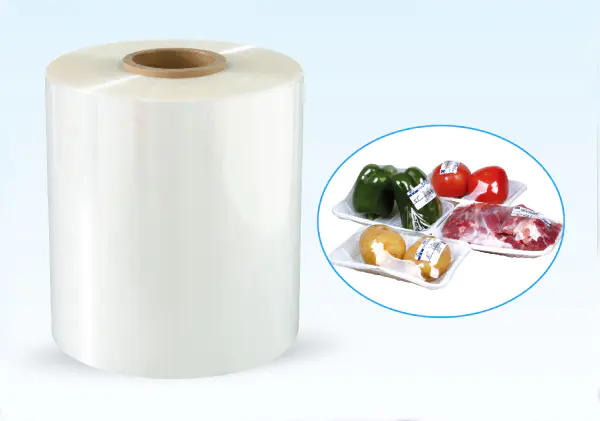
The most common family of films for this job is polyolefin, or POF. It offers balanced shrinkage in both directions, strong seals, good clarity, and food-contact approval for retail food packaging. PE shrink film is softer and cheaper for industrial loads, while PVC has largely fallen out of favour because of its chlorine chemistry. Crosslinked polyolefin film adds a molecular network that improves puncture resistance for sharp-cornered items.
The right setup depends on volume, not budget. If you wrap fewer than a few hundred units a day, an adjustable heat gun and an impulse sealer will handle almost any job for a modest investment. If you run a packaging line, an L-bar sealer plus a shrink tunnel gives repeatable results without depending on an operator's hand technique.
Keep the nozzle 10–20 cm from the film and sweep it in a slow circular motion. Air at the nozzle can reach 300°C, but the film temperature is what matters. The film is ready when it turns glossy and taut. Heat edges and corners last because those areas shrink fastest.
A tunnel controls air temperature, conveyor speed, and dwell time, which removes most of the guesswork. The package stays in the hot zone for 4–8 seconds, and the film shrinks evenly on all sides. For a growing business, this is usually the first upgrade worth making.
Whichever heat source you choose, start with the seam. A clean, even weld holds the whole package together, and our walkthrough on how to properly seal and shrink POF film explains the sealing mechanics in detail.
The process is short, but each step affects the next. Follow this sequence for both heat guns and tunnels:
For heat-sensitive products, switch to low-temperature film instead of lowering the tunnel setting alone. A lower temperature leaves standard film under-shrunk and baggy; a dedicated low-temperature grade shrinks fully without overheating the contents.
The film determines the heat range, the final appearance, and the level of protection. In practice, four categories cover most shrink-wrapping jobs:
| Film type | Typical tunnel air temperature | Best for |
|---|---|---|
| POF (polyolefin) | 150–180°C | Retail packs, food items, multi-packs |
| Crosslinked POF | 160–190°C | Sharp corners, heavy items, tear resistance |
| Low-temperature POF | 110–140°C | Chocolate, candles, electronics, cosmetics |
| PE shrink film | 180–220°C | Industrial goods where clarity matters less |
If you are not sure where to start, a standard polyolefin film is the most forgiving option. It shrinks evenly in both directions, seals cleanly, prints well, and is accepted for food-contact retail packaging.
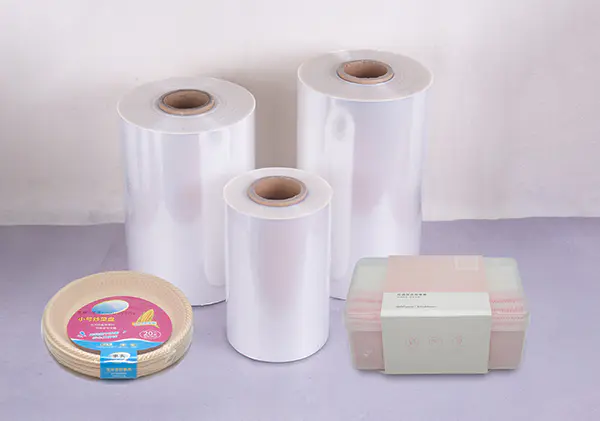 Standard Polyolefin Shrink Film for Balanced Shrink and ClarityThis biaxially stretched polyolefin film shrinks evenly in both directions, seals cleanly, and prints well. It suits general retail packaging where consistent performance and food-contact acceptance are needed.View Product →
If your product cannot tolerate heat, use a low-temperature film that completes most of its shrinkage at 110–140°C before the product itself warms up. This is the grade to choose for chocolate, lip balm, candles, and electronic modules.
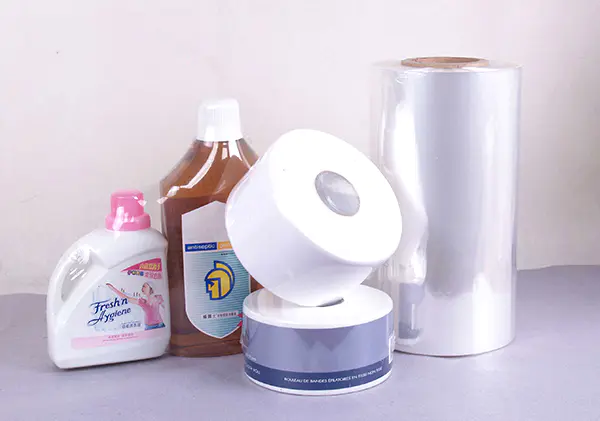
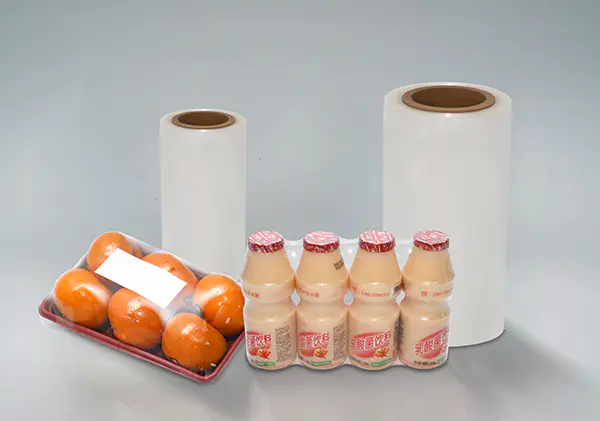 Low-Temperature Shrink Film for Heat-Sensitive ProductsThis film completes most shrinkage at 110–140°C, protecting chocolate, lip balm, candles, and electronic modules from heat damage. It offers flexibility, toughness, and high transparency for clear display.View Product →
For sharp corners, metal edges, or heavy units that punch holes in standard film, crosslinked film is the stronger choice. Its molecular network resists punctures and tears, which directly reduces returns and repacking.
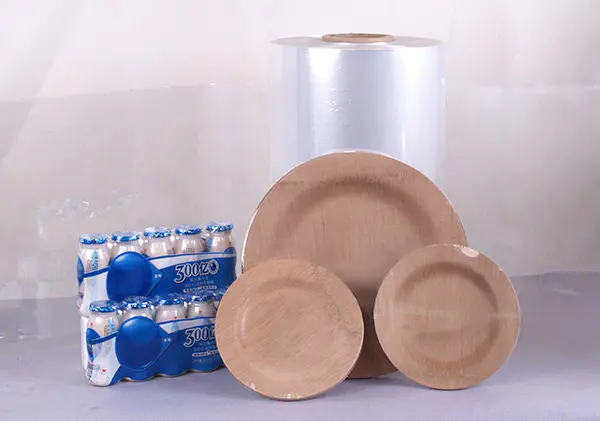
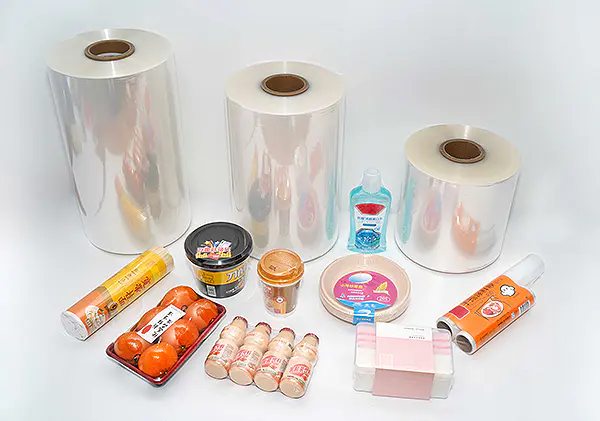 Crosslinked Shrink Film for Puncture and Tear ResistanceThis crosslinked film resists punctures and tears from sharp corners, metal edges, or heavy units. Its molecular network provides durability, making it suitable for demanding packaging and reducing returns.View Product →
With a heat gun, ignore the dial and watch the film. As soon as the surface turns glossy and tight, stop heating. With a tunnel, set the temperature inside the ranges in the table above, then adjust the conveyor speed so every package spends roughly 4–8 seconds in the hot zone.
If wrinkles appear near the package edges, raise the temperature by 5–10°C or slow the belt. If the film discolours, tears, or forms holes, lower the temperature or increase the belt speed. If you want to fine-tune the interaction between temperature, speed, and dwell time, our guide to shrink film heat settings explains how each variable affects the final pack.
| Symptom | Likely cause | Quick fix |
|---|---|---|
| Wrinkles on flat panels | Uneven or insufficient heat | Slow the heat-gun sweep; raise tunnel temperature by 5–10°C |
| Dog ears at corners | Film too small or heat too concentrated | Add 10–20% more film; sweep corners quickly |
| Burn-through or holes | Film too thin or nozzle too close | Use a heavier gauge; increase nozzle distance |
| Weak or brittle seams | Seal temperature too high or cooling rushed | Lower seal temperature; let seams cool for one second |
| Film sticks to the product | Hot film bonding to the surface | Use hot-slip film; let packages cool before stacking |
Almost every failure traces back to two variables: heat and film size. Change one variable at a time, and you will usually find a working setting within five test packs.
A household hair dryer is not a practical substitute: it moves too much air at too low a temperature, which creates patchy shrinkage. The reliable alternatives are a heat gun for small batches and a heat tunnel for production. For a one-off job, borrow a heat gun rather than improvising.
In a tunnel, most POF films run at 150–180°C, low-temperature POF at 110–140°C, and PE shrink film at 180–220°C. With a heat gun, watch the film surface and stop when it turns glossy and taut.
Polyolefin film can be food-safe, but the specific formulation and the supplier must meet food-contact regulations. Ask for FDA or EU food-contact documentation before using any film directly on food.
Allow 10–20% extra in each direction. Low and round products sit at the lower end; tall, heavy, or irregular products need the full 20% and sometimes edge protection underneath.
The difference between economical film and costly film appears in gauge consistency, seal strength, and shrink behaviour — problems that only surface after thousands of packs. When you source in volume, verify the supplier's certifications (ISO, BRC, FDA, SGS), request production samples, and confirm batch-to-batch consistency before committing. A manufacturer that controls raw-material quality and production tolerances will keep your line running at a lower cost per pack than a trader who simply resells commodity rolls.
Start with a standard POF grade matched to your machine, test it against your packaging line, and move to a specialty grade only if the test results show a measurable benefit.

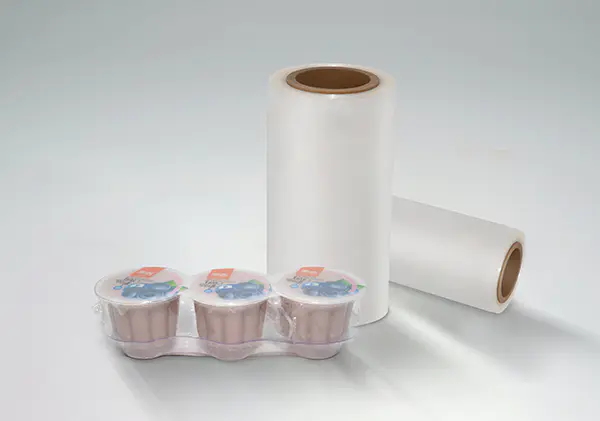


JT05 Antifog Crosslinked Shrink Film is an ideal o...
Copyright © Zhejiang Jiuteng Packaging Co., Ltd.
 简体中文
简体中文
 Home
Home
